Page 1 of 1

A Passenger To Bali

Posted: Wed Nov 25, 2015 5:38 pm
by Wellesnet
On 13 November 1938, Orson Welles's production of "Passenger to Bali" was broadcast on "Mercury Theatre on the Air," CBS-Radio. The 1936 novel by Ellis St. Joseph was a Flying Dutchman-type story. Welles later did a 30-minute version for The Mercury Summer Theatre in 1946. In the late 1950's, he co-starred with Curt Jurgens in a campier variation of the story called "Ferry to Hong Kong."

From the Escape and Suspense website:
Escape's "A Passenger to Bali" begins in a Shanghai harbor onboard a freighter named The Roundabout. The ship is about to depart when a man named Mr. Walkes convinces the captain to allow him to purchase passage to Bali. The Reverand Mr. Walkes is a Dutch missionary bound for Bali to distribute bibles and religion. Captain English allows him to travel on The Roundabout although technically, the freighter isn't supposed to take on passengers.

Soon afterwards, Captain English realizes he has made a horrible mistake. Manipulative, drunken, and murderous, Mr. Walkes slowly takes control of the ship by purposely inciting trouble between the British officers and the Kanaka crew.

When the ship arrives in Bali they learn that Mr. Walkes is an anarchist, unwelcome in any port in Indonesia. Everywhere Mr. Walkes has gone, he has caused trouble. No port will allow him to land. Now The Roundabout is doomed to wander from port to port with an evil passenger who can never disembark.

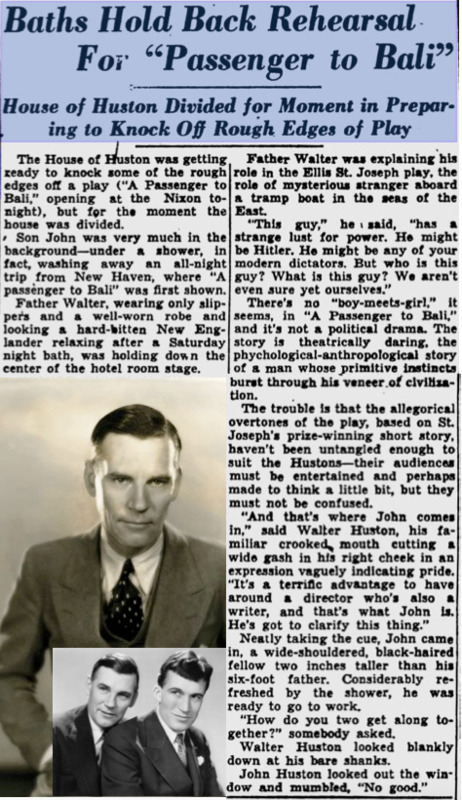
"A Passenger to Bali" became a 1940 Broadway play directed by John Huston and starring his father, Walter.
http://www.escape-suspense.com/2007/07/ ... -pass.html

Comments on the 1950 "Studio One" TV presentation, with EG Marshall as the Captain (Available on DVD Horror Collection from Mill Creek, which produced an excellent "Lady From Shanghai" DVD earlier this year):
"The story concerns a man who almost forces himself onto a cargo ship to be a passenger to Bali, hence the title. Unknown to the ship's captain or crew,he is a sea Jonah which no country wants and none will allow him off the ship and back on land. The reason is a bit unclear, we are told he has some 'inflamatory pamphlets' which could start trouble,as this was filmed during the 'red witch hunt' era in America's history,I assume it is the 'plague' of communism. It does seem all a bit silly from a modern day point of view, then again, there is the fear of Islam stalking the land now, so, perhaps not...

Berry Kroeger as the man without a country does a decent job, although you can see he has been watching too much Orson Welles when he gets into full flow and chews the scenery at times.

The ending is inconclusive and you have to add your own finale."

*

"...at one point, Mr. Walkes is seen reading "The Decline of the West" by Oswald Spengler. This book, which purports that the developed counties of the West (England, Western Europe and the Americas) were headed toward a new phase of civilization. This phase would be dominated by mega-cities, and money; and, that atheism would become ascendant. Following a progression, this would lead to Caesarism (cult of personality); and, a long period of stagnation in the arts and sciences."

*

Ellis St. Joseph's "A Passenger to Bali" originally aired as a "Mercury Theater" radio show in 1938, with the foreboding Orson Welles as the ship's mysterious passenger. At that time, the drama could have been argueably a warning against Fascism - but, by 1950, the evil was updated to Communism.
http://www.millcreekent.com/tales-of-te ... ovies.html
http://www.imdb.com/title/tt0712371/reviews

*

"Civilization is rotting because it's origin is fear. In order to entrap the strong, the weak entrap themselves."
- A Passenger to Bali
Re: A Passenger To Bali

Posted: Thu Nov 26, 2015 10:56 am
by Wich2
An odd but interesting show.

The central conceit also had reverberations of Melville's BARTLEBY, THE SCRIVENER for me.

(Actually, I'm surprised Orson never tackled that one...)

-Craig

Re: A Passenger To Bali

Posted: Tue Dec 01, 2015 9:52 am
by Le Chiffre
Interesting that you should mention the Melville story, which I'm not familiar with, but saw several sites comparing it to Kafka's THE TRIAL.

http://www.novelguide.com/bartleby-the- ... -questions
Franz Kafka’s The Trial (1925) has themes and motifs reminiscent of Melville’s story of Wall Street. Josef K. is a bank employee who wakes up one morning, finding himself arrested for some unknown crime. The surreal plot is meant to reproduce the anxiety of modern life with its meaningless repetition and dead ends. K. keeps saying he is innocent, and is asked, “innocent of what?” for the crime is never named. Guilt hovers over him for some unknown failure, even as he pleads not guilty. The book illustrates the arbitrary and absurd nature of modern life, which most people do not question. They accept the authority of others who decide their lives, playing out assigned roles. In the story, K. accepts his own execution as his only bid for freedom rather than waiting his whole life for the constantly deferred “trial” to begin. Kafka means the story as a parable for the human condition.

Similarly, Melville’s story of Wall Street is more than the story of a place in New York. Like all his fiction, it questions the meaning of life, without providing answers. The characters in Melville’s story are more types than individuals. Like “K.” everyone has a nickname or no name, except Bartleby. And he, though named, has no known background. He just appears, like a ghost, and at first he goes through the motions of playing the role of a copyist, but after a while, he can’t pretend anymore. He is always described as though already dead. He is powerless on Wall Street, except to protest: “I would prefer not to.” He looks out his window or waits on the stairs for the end, and like K., accepts his own execution rather than the lawyer’s terms. His only freedom is his refusal to accept the definition of life offered to him
.
Excerpt on "Passenger" from THE MEDIUM AND THE MAGICIAN by Paul Heyer:
From the beginning, theater never offered Welles any guarantees…many of the financial losses he incurred on stage were covered through his work in front of the microphone. ..Radio was both a consistent provider and a means of artistic expression…it offered easy access to an audience that theater, and later film, yielded grudgingly. The Mercury Theater broadcasts also allowed him to take frequent risks. A failed program one week could be quickly forgotten by a success the next. One such risk was taken on 13 November, 1938. Departing from its normal fare of presenting renowned literary works, Mercury broadcast "A Passenger to Bali", based on the novella by unheralded twenty-seven-year-old Ellis St. Joseph.

The story is a variation of the Flying Dutchman saga; lest there be any doubt, it opens with Bernard Hermann playing snippets from Wagner’s overture. Welles gives one of the most extreme and successful character portrayals he would bring to radio. He plays the allegedly Dutch, allegedly Reverend, Ralph Walkes, who boards a Bali-bound steamer in Shanghai. When Balinese authorities deny him entry, he proceeds to make himself at home on the ship, much to the chagrin of the Captain (Everett Sloane). With a suitcase of gin, an enormous appetite and implied physical size, Walkes exerts a Svengali-like effect on the crew that undermines the Captain’s authority. When Shanghai refuses to take him back, the Captain contemplates killing him. Walkes is totally aware of the situation and taunts him. The murder never becomes necessary, at least directly. A huge storm – the sound effects are impressive – leads to a shipwreck, whereby the Captain denies the reverend access to the lifeboats, forcing him to remain on the abandoned vessel.

Excellent performances by Welles and Sloane are bolstered by a keen-edged script in which every word is telling.
*

In it's theme of the confrontation between the captain of a ship and a mysterious stowaway, A PASSENGER TO BALI also bears a slight resemblance to Conrad's THE SECRET SHARER, which Welles would, in later years, record for the Japanese market:

Re: A Passenger To Bali

Posted: Wed Jan 14, 2026 4:24 pm
by Le Chiffre
Turns out the Hustons did a theater production of it in 1940:
Director: John Huston (his Broadway debut as a director).
Star: Walter Huston (John's father) playing the unwelcome passenger, Rev. Mr. Walkes.
Dates: Opened March 14, and closed March 16, after only four performances.

Image