Hello, I believe somebody on here will be able to help with this. Many years ago I read that Peter Bogdanovich once owned or had access to a frame blow-up of what was supposed to be the final shot of "The Magnificent Ambersons," but over the years he had lost it. Does anybody remember this story, and is there more to it than that?
And also, is there specific documentation as to what exactly this original final shot was? I seem to recall reading that it was a visual effects shot - Eugene walking down the street and around him is a matte painting of the modern city, visually signifying the fate of the Ambersons. I would love to know more about what this final shot entailed.
Thank you to anybody who can help.
The final shot of the original "Ambersons"
-
Dylan
- New Member
- Posts: 2
- Joined: Fri Mar 11, 2022 4:53 pm
-
jbrooks
- Wellesnet Veteran
- Posts: 396
- Joined: Mon Feb 25, 2002 1:00 pm
Re: The final shot of the original "Ambersons"
This discussion touches on it.
http://wellesnet.com/phpbb2/viewtopic.p ... 2&start=45 see Roger Ryan's 4:03 PM comment.
And I believe Joseph McBride discusses it in an extra on the Criterion blu ray of Ambersons.
Also see this interview with McBride --
https://sagharborexpress.com/joseph-mcb ... ilm-forum/
"I saw the frame enlargement of the final shot when Bogdanovich had it in 1970. It’s since been lost. It shows an overhead long shot of the polluted city with Eugene’s little car vanishing around a corner. There is an elevated train in the background, the car is surrounded by tall impersonal buildings, and smoke wreathes the atmosphere. It’s a hellish vision of what happened to our country in the modern machine age."
http://wellesnet.com/phpbb2/viewtopic.p ... 2&start=45 see Roger Ryan's 4:03 PM comment.
And I believe Joseph McBride discusses it in an extra on the Criterion blu ray of Ambersons.
Also see this interview with McBride --
https://sagharborexpress.com/joseph-mcb ... ilm-forum/
"I saw the frame enlargement of the final shot when Bogdanovich had it in 1970. It’s since been lost. It shows an overhead long shot of the polluted city with Eugene’s little car vanishing around a corner. There is an elevated train in the background, the car is surrounded by tall impersonal buildings, and smoke wreathes the atmosphere. It’s a hellish vision of what happened to our country in the modern machine age."
-
Roger Ryan
- Wellesnet Legend
- Posts: 1121
- Joined: Thu Apr 08, 2004 10:09 am
Re: The final shot of the original "Ambersons"
For the record, apart from McBride's memory of seeing a frame enlargement of this last shot, the March 12, 1942 cutting continuity of the full 131 min. initial edit describes the shot this way:
EXT. STREET LS - Car parked at right before boarding house - Tall buildings at end of street in BG - Light in windows, music heard playing - Car starts, drives to BG - Traffic passing on across street in BG - Car turns corner in BG - Exits - FADE OUT
This translates as an exterior of the street done in a long shot with tall buildings in the background. The phrase "car parked at right before boarding house" tells us that the boarding house Eugene is leaving is on the right side of the street. The music heard is undoubtedly a reference to the "End Title" music cue which begins on this shot (a somber slow cello is heard first before additional strings are added). While the cutting continuity as a whole is fairly detailed in describing screen action and character placement within the frame, it is less so when describing background action, set design, etc. In this case, there is no mention of an elevated train, but since McBride claims the train image was there in the frame enlargement and we have Welles specifically mentioning an elevated train is heard "clanking by", I see no reason why that couldn't be part of the background action, part of the passing traffic.
It was definitely a visual effects shot. Eugene's car would have been live footage as was, most likely, some of the foreground buildings (perhaps redressed storefronts seen earlier in the film), but the tall buildings in the background would have been a matte painting with the elevated train probably a miniature.
I was always frustrated that this particular frame enlargement could not be found in the two major archives (Lilly Library and U-M Special Collections Library) given that dozens of frame enlargements do still exist. It finally occurred to me that all of the frame enlargements found in the archives were printed in early February, 1942 (probably right after Robert Wise returned to California after working on a rough cut of Ambersons with Welles in Miami - immediately before Welles left for Brazil). They come directly from the camera negative. Since this final shot was a visual effects composite, it would not have been completed in early February, but perhaps later in the month or early March. The fact that is was not printed at the same time as the existing frame enlargements probably explains why it can not be found with the others.
EXT. STREET LS - Car parked at right before boarding house - Tall buildings at end of street in BG - Light in windows, music heard playing - Car starts, drives to BG - Traffic passing on across street in BG - Car turns corner in BG - Exits - FADE OUT
This translates as an exterior of the street done in a long shot with tall buildings in the background. The phrase "car parked at right before boarding house" tells us that the boarding house Eugene is leaving is on the right side of the street. The music heard is undoubtedly a reference to the "End Title" music cue which begins on this shot (a somber slow cello is heard first before additional strings are added). While the cutting continuity as a whole is fairly detailed in describing screen action and character placement within the frame, it is less so when describing background action, set design, etc. In this case, there is no mention of an elevated train, but since McBride claims the train image was there in the frame enlargement and we have Welles specifically mentioning an elevated train is heard "clanking by", I see no reason why that couldn't be part of the background action, part of the passing traffic.
It was definitely a visual effects shot. Eugene's car would have been live footage as was, most likely, some of the foreground buildings (perhaps redressed storefronts seen earlier in the film), but the tall buildings in the background would have been a matte painting with the elevated train probably a miniature.
I was always frustrated that this particular frame enlargement could not be found in the two major archives (Lilly Library and U-M Special Collections Library) given that dozens of frame enlargements do still exist. It finally occurred to me that all of the frame enlargements found in the archives were printed in early February, 1942 (probably right after Robert Wise returned to California after working on a rough cut of Ambersons with Welles in Miami - immediately before Welles left for Brazil). They come directly from the camera negative. Since this final shot was a visual effects composite, it would not have been completed in early February, but perhaps later in the month or early March. The fact that is was not printed at the same time as the existing frame enlargements probably explains why it can not be found with the others.
-
Le Chiffre
- Site Admin
- Posts: 2296
- Joined: Mon Jun 04, 2001 11:31 pm
Re: The final shot of the original "Ambersons"
If the final shot of the film was a special effects shot, then chances are it cost some time and money. Therefore, it's kind of surprising that RKO just trashed it instead of finding some other use for it in another film.
-
JMcBride
- Wellesnet Veteran
- Posts: 131
- Joined: Thu Nov 15, 2012 2:11 pm
Re: The final shot of the original "Ambersons"
But Peter Bogdanovich did have a set of
frame enlargements that included the
ending shot when I met him in 1970. He
said Welles had been given those enlargements.
So if the ending was finished later than
early February 1942, and Roger is
correct that Wise had enlargements
made then, the enlargement of the ending shot
had to have been made separately.
frame enlargements that included the
ending shot when I met him in 1970. He
said Welles had been given those enlargements.
So if the ending was finished later than
early February 1942, and Roger is
correct that Wise had enlargements
made then, the enlargement of the ending shot
had to have been made separately.
-
Colmena

- Wellesnet Veteran
- Posts: 165
- Joined: Thu Feb 23, 2012 4:41 pm
- Location: Cambridge NY USA
Re: The final shot of the original "Ambersons"
Above, Roger Ryan refers to the "1942 cutting continuity of the full 131 min. initial edit."
Where can one find this document?
How does it compare to Robert Carringer's "Reconstruction" in his U Cal Pr book of 1993?
-- thanks!
Where can one find this document?
How does it compare to Robert Carringer's "Reconstruction" in his U Cal Pr book of 1993?
-- thanks!
-
edmoney
- Member
- Posts: 69
- Joined: Thu Jan 23, 2003 10:24 pm
Re: The final shot of the original "Ambersons"
The core of the Carringer book essentially is the cutting continuity.Colmena wrote:Above, Roger Ryan refers to the "1942 cutting continuity of the full 131 min. initial edit."
Where can one find this document?
How does it compare to Robert Carringer's "Reconstruction" in his U Cal Pr book of 1993?
-- thanks!
-
Roger Ryan
- Wellesnet Legend
- Posts: 1121
- Joined: Thu Apr 08, 2004 10:09 am
Re: The final shot of the original "Ambersons"
Yes, I'm sure Welles was keen to see frame enlargements of special effect shots, so it's very likely that the ending shot, and maybe others, were printed later in the post-production process. For some reason, however, it appears that virtually all the surviving frame enlargements found in the archives were printed very early in the post-production process, prior to compositing or other effects being done (for example, there is an existing frame enlargement of Lucy being serenaded by potential suitors - an image that only appeared in the initial 131 min. edit reduced and composited over the left shoulder of George on the porch steps to represent George's daydream of Lucy. Of course, this composited image was not created "in-camera"; each element was photographed separately and it's this full-frame image of Lucy and the suitors that survives - photographic evidence of the final effect shot does not, apparently).JMcBride wrote:But Peter Bogdanovich did have a set of
frame enlargements that included the
ending shot when I met him in 1970. He
said Welles had been given those enlargements.
So if the ending was finished later than
early February 1942, and Roger is
correct that Wise had enlargements
made then, the enlargement of the ending shot
had to have been made separately.
edmoney wrote:Colmena wrote:Above, Roger Ryan refers to the "1942 cutting continuity of the full 131 min. initial edit."
Where can one find this document?
How does it compare to Robert Carringer's "Reconstruction" in his U Cal Pr book of 1993?
-- thanks!
The core of the Carringer book essentially is the cutting continuity.
Right, the core of the Carringer book might be considered an "adaptation" or "interpretation" of the cutting continuity, meaning the information presented in the book does not always align precisely with the document. Carringer admitted to making elisions and other editing choices to keep the information "more readable" in his viewpoint. Brian Rose, who has been studying the cutting continuity in minute detail as he prepares his Ambersons reconstruction, has discovered numerous instances where the Carringer book deviates from how the cutting continuity describes the visual and audio elements in a scene as well as shot lengths. A very notable error that I noticed is that the Carringer book implies that Welles' "George Amberson Minafer had received his comeuppance..." narration was added after the 131 min. edit was completed, when, in fact, the cutting continuity indicates the narration was already in place.
There are copies of the 131 min. edit cutting continuity archived at both the Lilly Library and at the U-M Special Collections Library.
-
JMcBride
- Wellesnet Veteran
- Posts: 131
- Joined: Thu Nov 15, 2012 2:11 pm
Re: The final shot of the original "Ambersons"
When I asked Peter Bogdanovich in the
late 1990s where the frame enlargements
I saw at his home in 1970 had come from,
he said, "Orson had them made."
late 1990s where the frame enlargements
I saw at his home in 1970 had come from,
he said, "Orson had them made."
-
Colmena
- Wellesnet Veteran
- Posts: 165
- Joined: Thu Feb 23, 2012 4:41 pm
- Location: Cambridge NY USA
Re: The final shot of the original "Ambersons"
If this closing scene had been retained it would have underlined the historical frame for Ambersons, which opens with the streetcar's leisurely, gracious collective mode of transport, and should have wrapped up with Eugene in his car, by himself, disappearing into the ugly city....
The removal of this final scene by RKO was part of their wholesale subtraction of the larger, surrounding historical pessimism in Welles' original edit, which thereby foregrounds the romantic pessimism.
PS Listening to a podcast on Ambersons this morning, wherein James Naremore refers to a BBC version that restores Welles' original edit.
Is that what we find here, which is timed at 1 hr, 25 mins?
https://www.bbc.co.uk/programmes/b0078b9s
Alas, it can only be played in the UK!
The removal of this final scene by RKO was part of their wholesale subtraction of the larger, surrounding historical pessimism in Welles' original edit, which thereby foregrounds the romantic pessimism.
PS Listening to a podcast on Ambersons this morning, wherein James Naremore refers to a BBC version that restores Welles' original edit.
Is that what we find here, which is timed at 1 hr, 25 mins?
https://www.bbc.co.uk/programmes/b0078b9s
Alas, it can only be played in the UK!
-
Roger Ryan
- Wellesnet Legend
- Posts: 1121
- Joined: Thu Apr 08, 2004 10:09 am
Re: The final shot of the original "Ambersons"
Hmm, I'm pretty sure there is no BBC-exclusive version of Welles' film that has anything that the officially-released version doesn't have.Colmena wrote: Fri Feb 10, 2023 7:38 am ... PS Listening to a podcast on Ambersons this morning, wherein James Naremore refers to a BBC version that restores Welles' original edit.
Is that what we find here, which is timed at 1 hr, 25 mins?
https://www.bbc.co.uk/programmes/b0078b9s
Alas, it can only be played in the UK!
I suspect Naremore is referring to the BBC-produced remake directed by Alfonso Arau which aired in 2002. At the time, the remake's publicity made a big deal that Welles' original script was being followed, but this is not really true. In fact, there are numerous additions that are not found in Welles' screenplay nor in Tarkington's novel including a truly dumbfounding scene showing George dancing a tango with his mother's corpse. Ironically, the remake ends with Eugene writing a letter to the deceased Isabel telling her about his reconciliation with George which is, indeed, a scene Welles included in his original shooting script. However, Welles ultimately rejected that scripted scene and substituted his new boarding house ending during principal photography.
-
Colmena
- Wellesnet Veteran
- Posts: 165
- Joined: Thu Feb 23, 2012 4:41 pm
- Location: Cambridge NY USA
Re: The final shot of the original "Ambersons"
In the Cineversary podcast #50, Aug 11 2022, honoring the 80th anniversary of Ambersons, James Naremore reports that after Eugene leaves Aunt Fanny's boardinghouse, there is an external scene which indicates that the boarding house is the re-purposed Amberson mansion! The scene has the mansion looking especially decrepit.
This scene is not found in Carringer's edition of the original cutting continuity or in Rosenbaum's summary in This is Orson Welles.
Does any know where Naremore might have learned of this crucial scene?
This scene is not found in Carringer's edition of the original cutting continuity or in Rosenbaum's summary in This is Orson Welles.
Does any know where Naremore might have learned of this crucial scene?
-
jbrooks
- Wellesnet Veteran
- Posts: 396
- Joined: Mon Feb 25, 2002 1:00 pm
Re: The final shot of the original "Ambersons"
The Boarding House was not the Amberson Mansion. See discussion here. http://wellesnet.com/phpbb2/viewtopic.php?f=20&t=1882
-
Steve Paradis
- Wellesnet Veteran
- Posts: 120
- Joined: Sat Sep 21, 2019 11:27 pm
Re: The final shot of the original "Ambersons"
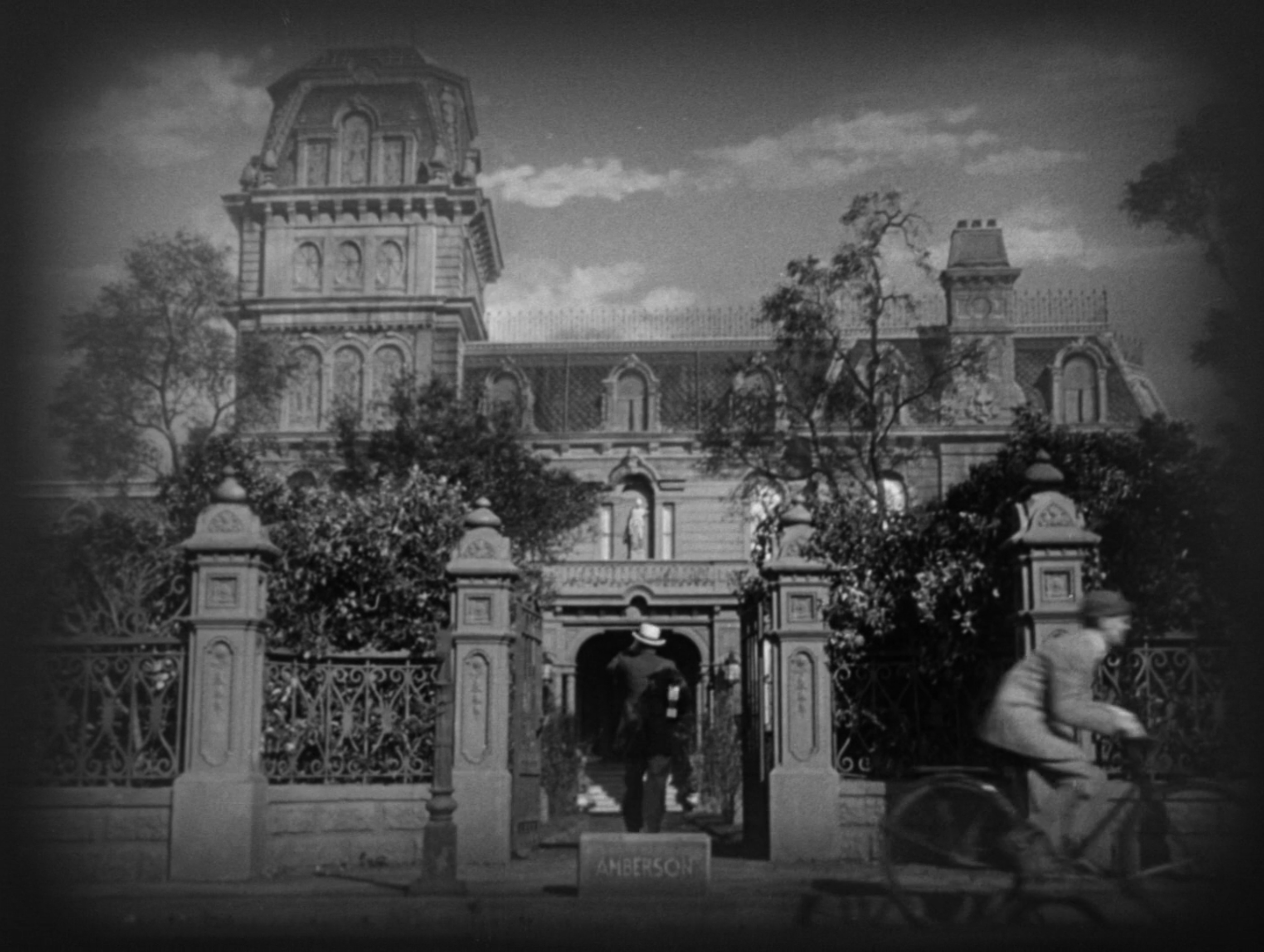
Could it have been the house we see over the opening narration. That's a "typical" home, and not the Amberson mansion, emblematic of the relatively idyllic world before the automobile took over. At the end it would have been seedy and crowded by tenements.jbrooks wrote: Thu Jun 08, 2023 12:19 pm The Boarding House was not the Amberson Mansion. See discussion here. http://wellesnet.com/phpbb2/viewtopic.php?f=20&t=1882

Don't recall seeing anything much of the exterior of the Amberson mansion except for a brief process shot.
-
Roger Ryan
- Wellesnet Legend
- Posts: 1121
- Joined: Thu Apr 08, 2004 10:09 am
Re: The final shot of the original "Ambersons"
Another casualty of the massive cutting. In the original 131 min. edit, there were far more shots of the mansion, often seen in brief establishing shots (like the extant shot of the guests arriving for the "last ball") which were inexplicably edited out. Was this done to quicken the pace? Probably. But these moments serve to provide a transition and reorientation for the viewer; it's really basic film grammar which Welles was abiding by. Cutting this footage just weakens continuity.Steve Paradis wrote: Mon Jun 12, 2023 2:41 pm ... Don't recall seeing anything much of the exterior of the Amberson mansion except for a brief process shot...
Again, the problem is the timing. The home seen at the beginning of the film on the fade in is directly across the street from the Amberson mansion. George and Fanny move into the boarding house upon leaving the mansion and it's only a matter of months before George has his automobile accident; not enough time for the city to build-up around these residences as described in the cutting continuity. Yes, the mansion will eventually be torn down and replaced with cheap housing, but the only logical location for Fanny's boarding house is closer to the city center than "Amberson Addition".Steve Paradis wrote: Mon Jun 12, 2023 2:41 pm Could it have been the house we see over the opening narration. That's a "typical" home, and not the Amberson mansion, emblematic of the relatively idyllic world before the automobile took over. At the end it would have been seedy and crowded by tenements.
Welles' later musing that he would like to re-shoot the ending in the late 1960s with the actors 25 years older would lend itself more to the idea that Fanny could very well be living in the built-up area that was once the Amberson property, but that kind of time has not passed in the film as it is... or as it was originally edited.